

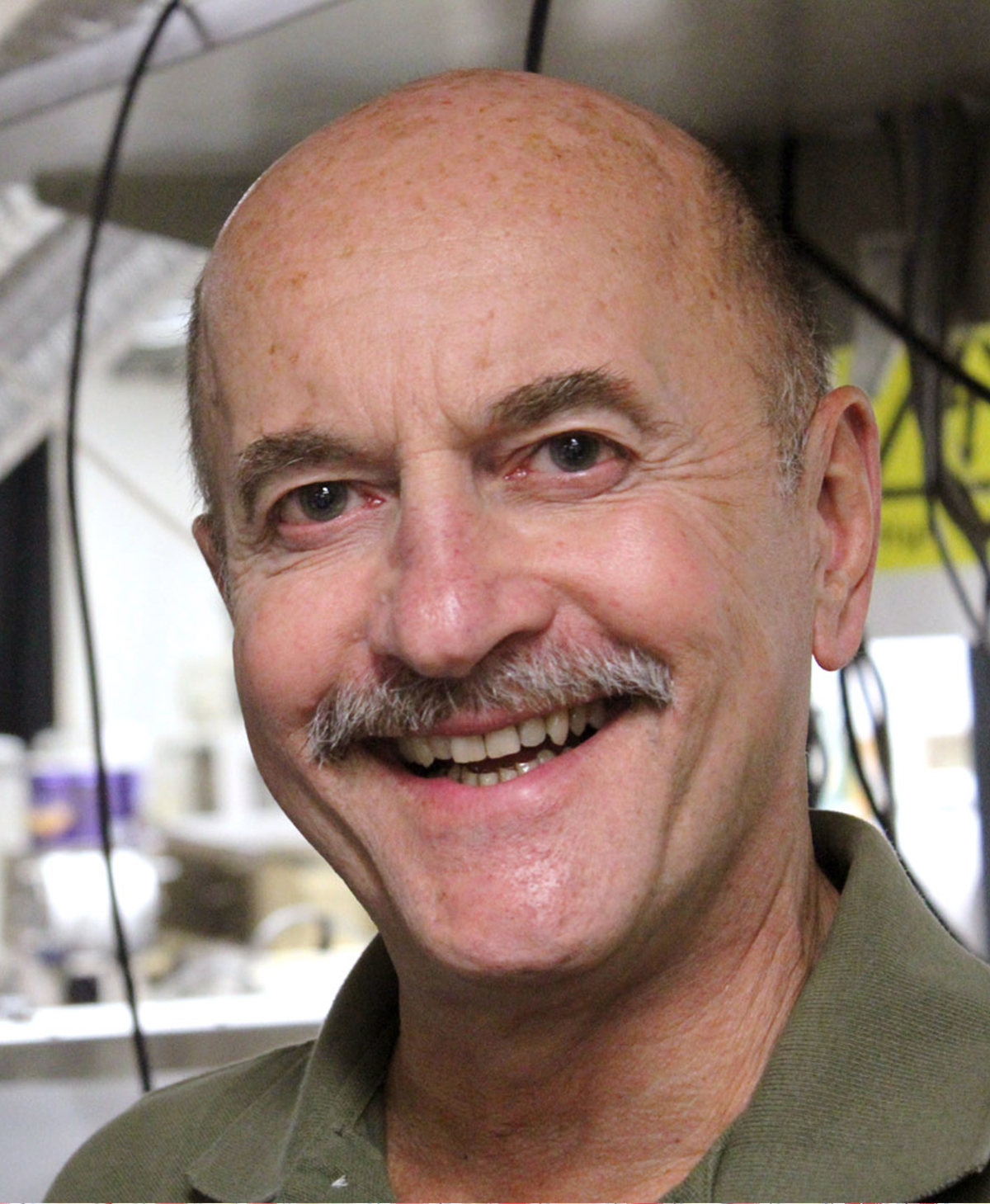
Professor Hieftje received an A.B. degree from Hope College, Holland, MI, in 1964 and a Ph.D. from the University of Illinois in 1969. He then joined the faculty at Indiana University as an assistant professor of chemistry. He became a full professor in 1977 and was named a Distinguished Professor in 1985. He is the author of over 500 scientific publications, 10 books, and holds 15 patents. Over 60 students have received doctorates under his direction; many others have received M.S. degrees, and scores of undergraduates and visiting scientists have performed research in his laboratories.
Professor Hieftje's research interests include the investigation of basic mechanisms in atomic emission, absorption, fluorescence and mass spectrometric analysis, and the development of instrumentation and techniques for atomic methods of analysis. He is interested also in the on-line computer control of chemical instrumentation and experiments, the use of time-resolved luminescence processes for analysis, the application of information theory to analytical chemistry, analytical mass spectrometry, near-infrared reflectance analysis, and the use of stochastic processes to extract basic and kinetic chemical information.
Research in our group generally involves the areas of spectrochemical analysis, chemical instrumentation, and information theory; with particular emphasis on mass spectrometry and optical techniques in the ultraviolet, visible, and infrared regions. Current projects include studies on basic atom formation, ionization, and excitation processes in flames and rare-gas plasmas, for use in atomic emission, absorption, mass, and fluorescence spectrometry; the development of new atomic methods of analysis; instrumental techniques to reduce the effects of background noise on measurements; computer-assisted chemical analysis; remote analysis based on fiber optics; near-infrared reflectance analysis; development of chromatographic detectors; plasma-source mass spectrometry; and picosecond time-resolved luminescence spectroscopy. Two of these projects are described briefly in the following paragraphs.
Flame and plasma atomic spectrometry are currently the most widely used techniques for elemental analysis. However, these methods are still impaired by interference among elements, limited sensitivity, and instrumental complexity. It is our firm belief that these limitations can be largely overcome by gaining a basic understanding of the underlying phenomena in each of the methods and then carefully designing improved instrumentation. To this end, we have a substantial ongoing effort to understand and mechanistically characterize the events leading to the formation, ionization, and excitation of atoms in flames and rare-gas plasmas. The efficiency with which atoms are formed, ionized, and excited governs both the sensitivity and the degree of elemental interference in such methods. Understanding the formation and excitation processes of atoms and ions will lead to a rational improvement in instrument performance.
In another area, novel mass spectrometers are being designed that are intended for use in the field of proteomics. A large fraction of known proteins contain metal atoms; in such situations, it is important to characterize not only the protein, but which metal atoms it contains, how many metal atoms there are, and if there is more than one kind of metal present. To address this problem, we have devised a novel time-of-flight mass spectrometer that accepts two ion sources simultaneously. When coupled to a separations device (LC or electrophoresis), this new tool is expected to be important in the characterization of proteins.

Thomson laser scattering system for acquisition of electron number densities and electron energy distributions in an analytical glow discharge (top-right corner)
"Chan, G.C.-Y. and Hieftje, G.M., In-situ Determination of Cross-over Point for Overcoming Plasma-related Matrix Effects in Inductively Coupled Plasma - Atomic Emission Spectrometry. Spectrochim. Acta, Part B, 63 , 355-356, (2008).
Andrade, F.J., Shelley, J.T., Wetzel, W.C., Webb, M.R., Gamez, G., Ray, S.J., and Hieftje, G.M., Atmospheric Pressure Chemical Ionization Source. 2. Desorption-Ionization for the Direct Analysis of Solid Compounds. Anal. Chem., 80 (8), 2654-2663, (2008).
Andrade, F.J., Shelley, J.T., Wetzel, W.C., Webb, M.R., Gamez, G., Ray, S.J., and Hieftje, G.M., Atmospheric Pressure Chemical Ionization Source. 1. Ionization of Compounds in the Gas Phase. Anal. Chem., 80 (8), 2646-2653, (2008).
Chan, G.C.-Y. and Hieftje, G.M., Use of Vertically Resolved Plasma Emission as an Indicator for Flagging Matrix Effects and System Drift in Inductively Coupled Plasma–Atomic Emission Spectrometry. J. Anal. At. Spec., 23 (2), 193-240, (2008).
Chan, G.C.-Y. and Hieftje, G.M., Warning Indicators for the Presence of Plasma-related Matrix Effects in Inductively Coupled Plasma- Atomic Emission Spectrometry. J. Anal. At. Spec., 23 (2), 181-192, (2008).
Webb, M.R., Andrade, F.J., and Hieftje, G.M., Compact Glow Discharge for the Elemental Analysis of Aqueous Samples. Anal. Chem., 79 (20), 7899-7905, (2007).
Webb, M.R., Andrade, F.J., and Hieftje, G.M., High-Throughput Elemental Analysis of Small Aqueous Samples by Emission Spectrometry with a Compact, Atmospheric-Pressure Solution-Cathode Glow Discharge. Anal. Chem., 79 (20), 7807-7812, (2007).
Schilling, G.D., Andrade, F.J., Barnes IV, J.H., Sperline, R.P., Denton, M.B., Barinaga, C.J., Koppenaal, D.W., and Hieftje, G.M., Continuous Simultaneous Detection in Mass Spectrometry. Anal. Chem., 79 (20), 7662-7668, (2007).
Engelhard, C., Scheffer, A., Maue, T., Hieftje, G.M., and Buscher, W., Application of Infrared Thermography for Online Monitoring of Wall Temperatures in Inductively Coupled Plasma Torches with Conventional and Low-Flow Gas Consumption. Spectrochim. Acta, 62 (10), 1161-1168, (2007).
Webb, M.R., Andrade, F.J., and Hieftje, G.M., Use of the Electrolyte Cathode Glow Discharge (ELCAD) for the Analysis of Complex Mixtures. J. Anal. At. Spec., 22 (7), 766-774, (2007).
Webb, M.R., Andrade, F.J., and Hieftje, G.M., The Annular Glow Discharge: A Small-Scale Plasma for Solution Analysis. J. Anal. At. Spec., 22 (7), 775-782, (2007).
Chan, G.C.-Y. and Hieftje, G.M., Investigation of Charge Transfer with Non-Argon Gaseous Species in Mixed-Gas Inductively Coupled Plasma-Atomic Emission Spectrometry. Spectrochim. Acta, 62 (3), 196-210, (2007).
Gamez, G., Ray, S.J., Andrade, F.J., Webb, M.R., and Hieftje, G.M., Development of a Pulsed Radio Frequency Glow Discharge for Three-Dimensional Elemental Surface Imaging. I. Application to Biopolymer Analysis. Anal. Chem., 79 (4), 1317-1326, (2007).
Gamez, G., Lehn, S.A., Huang, M., and Hieftje, G.M., Effect of Mass Spectrometric Sampling Interface on the Fundamental Parameters of an Inductively Coupled Plasma as a Function of its Operating Conditions. Part II. Central-Gas Flow Rate and Sampling Depth. Spectrochim. Acta, 62 (4), 370-377, (2007).
Gamez, G., Lehn, S.A., Huang, M., and Hieftje, G.M., Effect of Mass Spectrometric Sampling Interface on the Fundamental Parameters of an Inductively Coupled Plasma as a Function of its Operating Conditions. Part I. Applied RF Power and Vacuum. Spectrochim. Acta, 62 (4), 357-369, (2007).
Indiana University scientists build a better mass trap
New technology may change the way common laboratory machine is made. Scientists at Indiana University and three other research centers have developed a more effective mass spectrometer, a device used by many scientists to find out what elements or compounds are in an unknown substance. >> Full Story
Interview: Having a Gas
Gary Hieftje tells Nina Notman about the fun side of science. >> Full Story
Designed and developed by Kevin Joseph Ruble in September 2008.